September 24, 2015

What Does Your Name Mean??

For Wo Chan

it means you can't change it
just because you can't pronounce it.
it means just because you can't spell it,
that you can't throw in extra letters
or take others away.

it means you can't shorten it
because you think it's too long
or that you can "americanize" it.
it means when you accidentally
and repeatedly fuck it up,
you’re actually doing it on purpose.

it means when some people read it
or hear it’s soft vowels and rolling r’s,
that they will instantly hate me.
it means people will assume
that i speak Spanish.

it means people think they have the right
to interrogate me about
where i'm from,
where i'm REALLY from,
when my family came here.

it means people think i'm holding
or that i know where they can get some.
it means if i have the day off from work,
people think i'm unemployed.

it means when i use my credit card,
i have to show a “valid” ID.
it means when i do show my ID,
store managers look closely at it
to see if it's real.

it means when a friend says it,
tension leaves my body.
it means I am safe
and that good things
are about to happen.
when a loved one says it
it assures I’ll respond with my heart.

it means when i see it published
all the pushing back against
the bullshit that surrounded it
was worth it.

it means when people with similar names
see it in an anthology next to other
beautiful harmonious names,
that they can smile knowing,
but not fully knowing, the journey
it took to get them on the page.

it means we can love own names
and forgive ourselves
for all the times
we hated them. 

February 23, 2015

'Tending Hands' on Public Radio International

Me and my dad around 1970
Here is an expanded version of my farmworker post, 'Tender Hands' featured on my other blog, The Last Year

'When I was 10 years old, I began working regularly with my family as a migrant farmworker. I'd done it previously, but only on Saturdays, to help them catch up when tornado warnings ended work early or when the patches of weeds were particularly thick. The summer of my fourth grade year, it became my full-time job.'

Read the entire essay at Public Radio International. 

I’m thankful to PRI’s Anglilee Shah who read my original post and reached out to me to feature it on PRI.

January 16, 2015

Undocupoets: End Contest Discrimination!

Poets Launch Petition to End Citizenship & Residency Requirements in Contests


Roque Dalton García

"Too often, the submission guidelines read “Proof of US Citizenship” or “Legal Residents Only.” This small, but powerful, statement serves to exclude 11.7 million undocumented people (according to the Pew Research Center Hispanic Trends Project in 2013) from participating in a multitude of poetry opportunities—from first book contests to applying for major grants."

I work with amazing poets who happen to be migrant farmworker youth and I'm proud to have signed this petition. Chances are that some of the youth are undocumented. I don't ask. If they want me to know, they'll tell me either in person or or in their writing.

They are part of the reason I write to share our stories, our lives. My hope is that they will embrace their natural storytelling skills and become writers or at least be more confident in their ability. I know it's only a matter of time until one of them, one of them takes the brave step to submit work for publication.

That's why I signed the petition.

According to the organizers, some journals say they must support citizenship/residency requirements because they receive federal funds. Yes, that's true. However, having worked at nonprofits, I can tell you there are times when federal residency requirements are not and cannot be collected (street outreach, public lectures, workshops/panels, etc.). Even if it were possible to collect the information, nonprofits don't have the resources to investigate and confirm residency or citizenship claims.

Since it's unlikely that states and the federal government will eliminate such residency regulations in funding, there's a way around it -- DON'T USE STATE OR FEDERAL FUNDS FOR THESE CONTESTS.

I get it, offering a prize like publication of book is a really big deal and it can cost thousands of dollars. If an organization relies on one funding source for such an endeavor and that one source is the state or federal government, it's only a matter of time before said funding is restricted or eliminated. Clearly, the organization has bigger problems than keeping undocupoets from submitting work.

Aside from first book contests, some journals offer a cash prize. While some cash prizes are in the thousands, usually a contest prize is less than $500. Some offer no prize at all other than publication of the work and maybe a free copy (or discounted copy) of the journal. What's the logic in excluding undocupoets from these contests?

I know things are rough for presses and journals, but with the recent efforts of #WeNeedDiverseBooks and #DontSelfReject, excluding voices from publication based on residency is about as crazy as limiting them based on education (don't get me started on that). 

Because of these and similar efforts, presses and journals now feel the urgency for diversity in publication (whether they act on it is a different story). But maybe these publishers simply want the diversity of a community college course catalog where an older white guy sits at a table with a Black girl who has her book open while an obviously young Gay Latino on the other side of her smiles. An Asian man at the same table laughs at a joke and white girl sits in a wheelchair holding a tablet as they all study at one of the many outdoor study areas. It's fun, it's pretty, and most of all it's not complicated. 

Perhaps some publishers use this residency regulation to screen out possible "complicated" diversity that comes with undocumented writers, trans writers, disabled writers, or other writers with "intense"  or "messy" (meaning possibly offensive) issues. Avoiding complicated diversity means silencing complicated voices, negating complicated stories and histories, and ultimately shunning complicated readers. That might be alright with them but it's not alright with me.

One day soon a young farmworker from the Midwest, perhaps undocumented, who has shared her story only with a select few, will feel the support and encouragement of her mentors and friends. And with a prayer on her breath, she will be bravely submit her words to a contest for publication. 

Not only does she deserve the chance to win, she deserves an opportunity to be heard.

November 25, 2014

My Ferguson Story

I didn't want to leave the house today.

After last night's news of the failed successful non-indictment of Michael Brown's killer, I just didn't want to see people going about their lives. I didn't want to hear helpless sighs and patronizing conversations about healing or moving forward. I didnt want to hear people's mouths shooting details of the riots or debating the character of a dead boy.

But I had an engagement at the Kansas City Art Institute and I promised a friend that I'd attend. So I dragged my brown ass to downtown KCMO and roamed the campus like someone's lost father as I looked for the venue.

Inside the small auditorium students gathered displaying their work, sharing food, and ... they were living. They were laughing and having fun. It kinda bothered me. I mean, how dare they?

As I looked closer I could see the students were Latino. The art was Latino. The food was Latino. My cheeks started to burn and my chest tightened.

I realized this is where I needed to be. I needed to be around the young creative energy of my own culture, not locked away in my house Tweeting and posting my outrage.

As part if the event, the organizers asked my friend Maria and I to read a few poems. Not having brought my notebook, I briefly panicked but then I remembered I'd uploaded some poems to my Google Drive for just such an occasion.

I read one of my fat poems, I'm Big and I'm Brown All the Way Down; my poem about being the first to go to college, F1RST; and my signature poem, Madre de los Campos.

After that poem, which deals with my frustration as a young kid at being a farmworker, I wanted to talk to about Ferguson. I needed to talk about it. I was experiencing the same frustration as the boy in my poem but at the same time I felt the safety and comfort of the room.

We talked about our art. We talked about how we long to create beauty and joy through our work but that there is also beauty in pain. We have a gift and sometimes that gift requires sitting in our pain, processing it, and putting it through the artist's lens.

It means taking what's inside our hearts, inside our heads and on our tongues and putting it in words, on canvas, or in clay -- that's our ability, our gift. It's our super power. In doing so, we can help others process their feelings. We can stand as examples to young people on creative ways to deal with these difficult emotions that make so many turn to, and live in, rage or to simply shut down -- shut down like I wanted to do hours earlier.

I don't know what will come from the meeting today. Hopefully it will be the beginning of new partnerships and collaborations for area Latinos in the arts.

But for now, for this moment, it's what I needed. I needed to be among brown and black faces who connected in a safe space surrounded by and sharing our creative energy.

That's my Ferguson story.

September 5, 2014

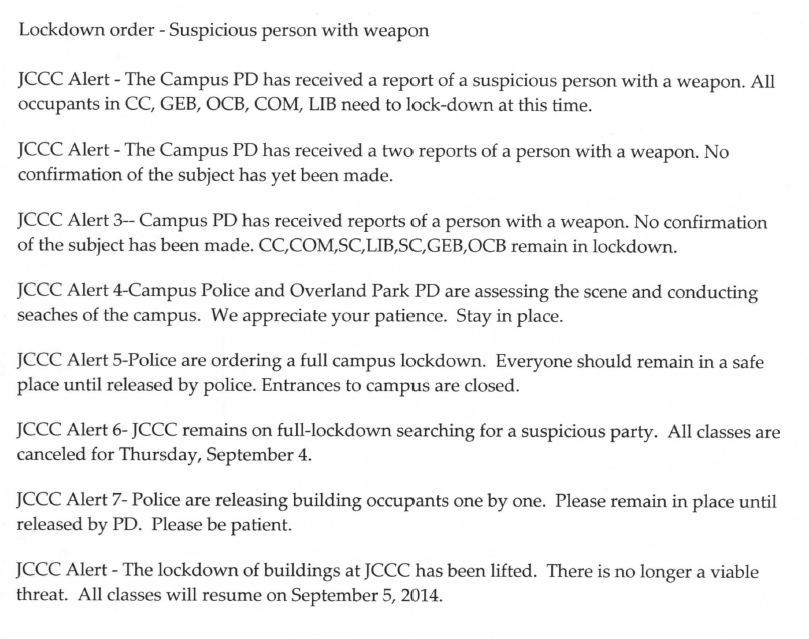
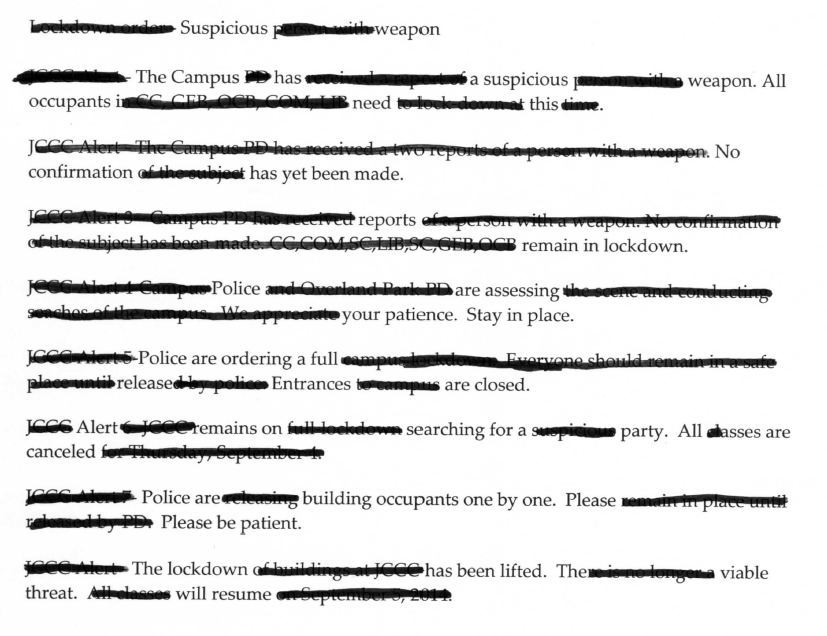
#JCCC Alert/Suspicious weapon

Alerts issued by my college yesterday after reports of an armed assailant was spotted on campus:


My poem from those alerts: