Showing posts with label KACP. Show all posts

February 27, 2012

¡Viva la Evolución!


I created The Latino Reporter blog in 2004 to help me focus on journalism.  When I began immersing myself into the world of nut graphs, column inches, and inverted pyramids, this blog helped me understand journalism's particular style of writing. I learned many lessons but the most important: listen to my writer's voice.

While exploring journalism as a student, I uncovered a scandal that toppled my college president. I earned several national and state awards including the First Amendment award from the Society of Professional Journalists.

I could (and just might) write a book on how journalism changed my life and my campus. 

In the last few years as I shifted my brand from The Latino Reporter to TrustMiguel, my writing skills expanded (as has my waistline). It took time but I'm as comfortable writing poetry and fiction as I am a writing a news story or an editorial -- and I'm just as proud. 

Since I'm still learning about this new non-journalism world, it only seems right to resurrect this blog to help me process once again. Like an old college buddy, it only took moments to reconnect but it's clear that we've both changed. The challenge is not to stay mired in the past but to build on it.

The Latino Reporter is now The Latino Writer, part of the TrustMiguel brand. I'll tell you more about that later ...

June 12, 2008

TIME OUT: My Electability


Here is an e-mail I sent to the National Association of Hispanic Journalists' GLBT Caucus, of which I'm a member:
I'm running for the Student Representative position on NAHJ' Board of Directors. I'd appreciate your support in helping me get the number of petition signatures via e-mail needed (25) to stand as a candidate.

For those who don't know me, I'm a non-traditional student living in Kansas. I attend Johnson County Community College in Overland Park, Kan. and Emporia State University in Emporia, Kan. NAHJ selected me as a participant in both the Student Campus and Latino Reporter projects in the past as well as awarded me a Ruben Salazar Scholarship. The Society of Professional Journalists awarded me it's 2006 First Amendment Award for my investigation that uncovered allegations of sexual harassment against my college president and the open records battle that followed. I've also won several first place writing awards in state competitions where I also earned the Journalist of the Year award. I've participated in the Associated Press' Diverse Visions/Diverse Voices program, the National Press Foundation's Introduction to Washington program, and the National Lesbian & Gay Journalists Association student projects. Of course, I am also a member of the NAHJ GLBT Caucus.

If you feel that as a member in good standing you can support my efforts, please use the following template to send your e-mail to ravila@nahj.org by June 18.
I (STATE YOUR NAME), of (COMPANY THEY WORK FOR OR OTHER FORM OF IDENTIFYING EMPLOYMENT) support the candidacy of _________________ for (position) ____________________ in the 2008 election of the NAHJ Board of Directors. This statement counts as my virtual signature and I have included my full contact information below.
Thanks for this opportunity to serve an organization that has served me,

miguel
If I secure enough e-signatures to be on the ballot, I'll layout my platform points because I definitely have ideas on the direction NAHJ needs to head and how students can help the organization get there.

May 9, 2008

COMMENTARY: Regret the Error

Walking on the Ledge:
Errors that Influence
Was Learning Management System Vote Tainted by Student Newspaper?

Every campus newspaper staff wants to influence campus – but not through errors.

An article in the April 24 issue of The Campus Ledger reported Johnson County Community College (JCCC) will abandon its current Management Learning System (LMS) powered by Blackboard in favor of one powered by ANGEL Learning. The article also reported the LMS will be in place by fall 2008.

The problem? The faculty was in the midst of conducting a vote on whether to adopt ANGEL. A day after the story ran, a posting on the college's electronic mail server, Infolist, voiced faculty concerns.

“Contrary to the Campus Ledger article, the college's move to ANGEL Learnin
g is not a forgone conclusion,” the post read. “We're in the middle of the faculty vote to support or not support the move to ANGEL Learning. Faculty votes count and are crucial as no decision will be made until the voting time period concludes on Monday, April 28, 2008 at midnight.”

The posting said if the vote is affirmative, the faculty’s recommendation moves to the Academic Technology Advisory Council, the Executive Council, the Board of Trustees’ Finance Committee and then to the entire Board of Trustees. A negative vote from faculty could stop the process, as could a negative finding by any of the committees along the way.

“If approved by all parties, the timeline for the implementation of a new LMS still needs to be developed,” the posting continued. “Any assumption that faculty and students will be using a different LMS for fall 2008 is premature. Implementation will require more time than exists between the board vote and the start of fall classes.”

Read the faculty post here.

A few faculty members asked how the paper could publish these errors and who, if anyone, checks facts. I explained the editing process I helped establish during my tenure at The Ledger. A minimum of three editors check the story and the staff reviews the proofs, or “minis,” for errors on production night. Yet, I agreed the article’s factual errors also could serve as errors that influence.

“Maybe this calls for something more than running a correction in the next issue, perhaps a staff ed?” I wrote in an April 29 e-mail to the Ledger's adviser, editor in chief, and managing editor. “I know the situation sucks because everyone loves to point out when The Ledger makes a mistake. But if it's not addressed then the integrity of the paper suffers especially on the heels of some prestigious awards this year.”

The next day, six days after publishing the article, The Ledger posted a correction and apology on Infolist.

“It has come to the attention of The Campus Ledger that the April 24 article about the Blackboard Learning System contained incorrect information,” the post read. “It was not our intention to sway the vote for a new learning management system ... Our staff will take this experience to heart. We plan to continue providing the quality, accurate news that you have come to expect from our award-winning newspaper.”

Read The Ledger post here.

Seeing this as a teachable moment, I asked the Ledger's adviser, editor in chief, managing editor and the reporter how the situation unfolded.

Linda Friedel, managing editor, acknowledged ethics breach.

“We definitely consider it a learning moment,” Friedel said. “It is the worst mistake anyone has made on the Ledger this year.”

She said a meeting took place yet they could not identify the origin of the mistake.

“Either the reporter didn't make the question clear, the source spoke out of line, the source didn't communicate it was a done deal and the reporter thought it was a done deal,” she said.

Friedel said the most they could do was acknowledge the mistake and use it as an example of how not tor report.

Alexia Lang, editor in chief, did not respond to my question.

Anne Christiansen-Bullers, adviser, said she would meet with the reporter and Lang to discover how the errors happened.

The reporter, Bartholomew Klick, said a few days after The Ledger's apology posted, Lang abruptly fired him. He said she cited the errors along with an e-mail campaign he spearheaded against The Ledger for an unrelated story as reasons for his termination.

Yet, Klick contends he accurately reported the story. He said during the editing process, editors cut crucial information and left gaps they later filled with assumptions and other misinformation.

Klick provided his unedited copy showing the differences. His original lead reads:
“As quickly as autumn of this year, the college may have a new program for managing its online course material.”

The published version reads:

“Beginning this fall, the college will have a new program for managing its online course material.”

Read The Ledger article here.
Read Klick's original version here.

Klick said the only thing he regretted about the story was that he did not record and clearly document his interviews. Both he and Friedel agreed organized documentation would have identified errors and allowed corrections before publication.

Further complicating the situation is that everyone involved is an accomplished journalist. Klick and another staffer recently were awarded the college’s Robert J. Helmer award for excellence in journalism. Alexia Lang was named first runner up for the Kansas Associated Collegiate Press Journalist of the Year award in the two-year division. Friedel is a contributing columnist to The Kansas City Star’s Neighborhood News and Christian-Bullers has earned an advising award from the Collage Media Advisers association.

The faculty voted to endorse ANGEL Learning as it’s LMS. The recommendation now moves along the path to approval. Yet the question remains: did the reporting errors influence the vote?


Visit Regret the Error to read about media mistakes

April 9, 2008

AWARDS: All-State, Again

From the college's electronic mail server, Infolist:

THE CAMPUS LEDGER WINS AWARD
The Campus Ledger was named the best student newspaper in its division at a state journalism conference April 6-7 in Wichita. The student newspaper of Johnson County Community College was given the All-Kansas award by the Kansas Associated Collegiate Press for the second year in a row. To receive the award, the paper must score outstanding marks in all categories judged, including writing, visuals and design, based on three issues from the 2007-08 academic year. The editor of The Campus Ledger, Alexia Stout-Lang, was named first runner-up in the Journalist of the Year contest and received $100 from the Kansas Press Association.

Members of The Campus Ledger also received 24 individual awards, including six first-place certificates. Nathan Lang, former online editor, won first place in headline writing and news photography, and sports editor Stephen Montemayor won first place in sports-column writing and second place in sports features. Artist Juniper Tanpuz took first in illustration and both second and honorable mention in cartoons. The adviser is Anne Christiansen-Bullers. Individual awards included:

First place – Nathan Lang, headline writing and news photography; Justin Millard, sports feature; Stephen Montemayor, sports-column writing; Miguel Morales [emphasis added], column writing; Juniper Tangpuz, illustration.

Second Place – Katherine Kramer, interior-page design; Stephen Montemayor, sports feature; Miguel Morales, column writing and news writing; Juniper Tanpuz, cartoons.

Third Place – Matt Galloway, feature writing.

Honorable Mention – Campus Ledger Staff, news writing; the team of Jennifer Hallock, Alexia Stout-Lang, Linda Friedel, Miguel Morales and Stephen Montemayor, special section; Matt Galloway, sports feature and news writing; Katherine Kramer, interior-page design; Justin Millard, sports news; Stephen Montemayor, sports feature; the team of Miguel Morales and Kevin Mimms, news writing; Miguel Morales, headline writing; Alexia Stout-Lang, column writing and review writing; Juniper Tangpuz, cartoons.

September 12, 2007

NEWS: You really like me!

Ledger earns two more honors
Kudos continue for staff that covered campus controversies

The Campus Ledger, the student newspaper of Johnson County Community College, earned two prestigious honors from two separate journalism organizations for its 2006-07 editions.

Pacemaker Finalist designation from the Associated Collegiate Press. This award, known as the Pulitzer Prize of student media, goes to the top college newspapers in the country for overall quality. The Ledger competes against 14 other community college newspapers for the award presented at the ACP's National Convention Oct. 24-29 in Washington, D.C.

Gold Medalist rating from the Columbia Scholastic Press Association. The medal rating reflects the judge’s overall score of 945 of 1,000 points, including an All-Columbian, or “best of best” rating, in The Ledger’s reporting and coverage of campus events including the investigation into multiple allegations of unlawful harassment and the search for a new president. The Gold Medalist rating is the result of an extensive evaluation of the entire year’s publications.

The Ledger also earned the All-Kansas award, the top award for college media, from the Kansas Associated Collegiate Press last spring. Over the summer the paper won Best in Show from ACP for overall coverage and design.

April 27, 2007

AWARD: All-Kansas

The Campus Ledger earned its place as the best student newspaper in its division at a state journalism conference April 16-17 in Wichita, Kan.

During the culmination of the Kansas Associated Collegiate Press (KACP) conference and award ceremony, KACP announced the student newspaper of Johnson County Community College earned its All-Kansas award. To receive the award, the paper must score outstanding marks in all categories judged, including writing, visuals and design.

Members of The Ledger staff also earned 26 individual awards, including seven first-place certificates.

KACP named Miguel M. Morales, news editor, first runner-up for Journalist of the Year for his efforts in breaking and following the allegations of sexual harassment agains former college president Charles Carlsen. Morales also collected seven individual awards. KACP previously named Morales Journalist of the Year in 2005.

Individual awards included:

First Place
Ryan Arthur - news photography
David Daneman - Cartoons
Miguel Morales - news writing, column writing (tie)
Juniper Tangpuz - illustrationsAaron Whitebread - column writing (tie), sports features

Second Place
Stephen Montemayor - sports news writing
Morales - news writing, series writing, headline writing
Matthew Walsh - front-page design

Third Place
Ledger staff - editorial writing
Justin Millard - sports column writing
Kevin Mimms and Walsh - infographics
Whitebread - review writing

Honorable Mention
Millard - sports news writing
Montemayor - sports features, sports column writing
Morales - editorial writing, review writing
Tangpuz - cartoons
Weston White - sports photography (3 awards)
Whitebread - sports column writing

April 14, 2007

TIME OUT: Source Sourcery

This is part of my presentation covered at the KACP workshop "Handling the Big Story on Campus"

Reliable Sources:
How to get people on campus to talk

  • Remember names - Learn the names and titles of all the upper-level administrators and department heads. While no one likes to be thought of as their job title, many in academic institutions (especially the higher up the chain they are) like to be addressed as Dr. So-and-So or Dean Whoever. Don't become over familiar with these sources by using their first names, unless they ask you to.
  • Say "Thank you" - In addition to thanking a source at the moment, let a day or so pass and thank him or her again. Sometimes sources get nervous about what they may have said. A quick call, e-mail or note lets them know you understand what it took for them to meet with you in the first place.
  • Be human - If people see you as a sensationalistic, headline-busting, one-purpose newshound who's only interest is getting the story, they wont trust you. And why should they? To you, they're just walking quotes. However, if they see you as a real person, they can relate to you. Notice their office or desk and talk about similar interests. Talk about the weather. Just talk -- and not as a way to wear them down -- really talk to them. Be interested.
  • Fair to all, large and small - While its important to know the top-level administrator and department heads, know those who come in contact with them (administrative assistants, the person in the food court who serves them coffee, the custodian who cleans their office). These individuals' stories may not support your investigation but that doesn't mean their stories don't deserve to be told.
  • Finding Mr. or Ms. Right - Every division, every department, every office has an "it" person. Not only does this person know everything and everyone, he or she usually collects memo, e-mails and other documents. You need to know this person and you need have those documents. Cultivate -- not manipulate -- a relationship with this person. They usually won't want to go on the record, but who cares? They have all the background and with their documentation, you probably don't need them on the record.
  • Never miss a chance to do a simple favor - Use your resources to help out a source. If a source has a to research something campus related, take the initiative to search through old issues to see how the campus paper covered it and present him or her with a copy of the article. If a source is interested in buying or selling an item let him or her know if your papers offers free classified ads for students and staff. If one of their tips or quotes makes it into the paper, hand deliver the source a copy and say thanks. Note: When a sensitive article gets published hand delivering a copy might make your source look like a snitch. Use your best judgement.
  • Return phone calls, even the painful ones - Not returning phone calls tells a source that he or she doesn't matter to you. Sometimes a sources is simply feeling nervous and needs to talk about it or he or she just wants to chat. So chat and listen. Never give people -- especially sources -- the impression that their story ideas are silly. Even when they are.
  • Check in - Sources get nervous and sometimes they need to freak out to the one person they trusted with their story. Let them release some steam because if they keep it inside, you'll get the call saying they don't want to do the story. So check in to make sure they are doing OK. Keep them updated on your progress. Let them know how they fit into the story. They shouldn't be surprised about their participation when they pick up the paper.
  • Don't bitch and moan - It sounds simple to avoid this behavior but its not. Sources will encourage you to talk smack. Its okay to empathize with them but follow the best friend breakup rule: don't trash your best friend's ex when they break up because they just might get back together. Don't endanger your credibility by trashing someone or by whining about your editor or adviser. That doesn't instill sources with confidence in trusting you or your news organization.
  • Confidential contact - With sensitive information, advise employees not to contact you using college provided avenues of communication (employee e-mail, interoffice mail, voice messages, etc.). Legally, the college can intercept/monitor communication on its systems. Have other avenues set up for confidential communication.
  • Train sources to contact you - Many times we get our tips simply because we bump into a source as we walk across campus or when we make the effort to call them. In addition to teaching sources how confidentially contact you, teach them when to contact you like when
  • they come across information that they find interesting
  • someone gets hired, fired, promoted, awarded, or in any other way their job changes
  • things are "too" normal
  • their work flow suddenly increases or decreases
  • Walk with them - Its simple to try to conduct everything via email or over the phone. But sometimes people don't get back with you. Go to their office, they cant hang up on you when you're face-to-face. If a source can't meet with you because he or she is going to a meeting, class or home, walk with him or her. The ones who are truly busy will be glad you accomodated theri packed schedules and the ones who tried to hide from you will know next time to take your call -- or you'll hunt them down.
  • Break bread - Use those social lubricants like lunch, dinner and coffee breaks to engage sources. Because you are both out of the office, avoid using pressure tactics to get them to talk. Its lunch, not an interrogation. Note: even though you are a poor student journalist, don't let your source pay for you.
  • Always protect your source - Don't name drop with other sources or others in the newsroom. If information is off the record, its OFF THE RECORD. In a micro-community like a college, word spreads quickly if you burn a source. Conversely, word will spread if you can be trusted.
  • Enlist "source references" - Usually when you do win a source's trust, the source will tell his or her friends about you -- encourage this. However, if you're having trouble securing a source's trust, ask if it is OK to have another one of your sources contact him or her to speak of your ethics and integrity. Of course, this means first identifying a source who is willing to be your "source reference."
  • Repeat the rules - Journalists are usually pretty good about explaining on the record, off the record, not for attribution, etc. However, sources don't always remember what they agreed to initially. Remind them of how their information will be used according to your agreement. That agreement can always be renegotiated but don't give up something unless you get something equal or better in return.
  • That thing you do - Sometimes sources try to get all "deepthroat" on you for no reason. Don't let them. Explain how the reporting process works. Describe how information must be triangulated. Tell them you don't call all the shots and that you report to an editor who wouldn't believe the sky was blue if Abraham Lincoln showed him a picture if it. Tell them that sometimes stories don't get published for reasons beyond their and your control. But most of all tell them you're going to be accurate and fair -- and then, be accurate and fair.
  • Ask for help - Use other's expertise. Ask them to help you find out about XYZ ; ask them to explain how ABC works or ask for the history of JKL. Although it may not seem like it all the time, people who work in colleges really want to be of service -- so let them.

Miguel M. Morales, Johnson County Community College, for the Kansas Associated Collegiate Press convention - April 16, 2007
adapted from a handout by Larry Welborn,
The Orange County Register

April 13, 2007

TIME OUT: Working the 12 Steps

This is part of my presentation covered at the KACP workshop "Handling the Big Story on Campus"
Reporting Scandals:
12 Steps for Covering Sensitive Stories on the Administration

  1. Document everything - Keep a reporter's log narrating the obstacles and accomplishments in reporting the story. Its a safe way to express your the emotions and keep them out of the news story. Also reporters sometimes become the story. Use the log as a tool to show you did your homework. It is also helpful if you end up filing a grievance against an administrator who's attempting to stop publication of your article.
  2. Notify SPLC ASAP - Avoid of Libel by using the Student Press Law Center. The SPLC site also contains a comprehensive report: "A Dozen Tips to Avoid Being Burned by a Hot Story," and a State Open Records Law Request Letter Generator. The letter generator helps students submit state open records requests by citing the statues of their state.
  3. Memorize policy - Well, at least know what administrators are talking about when they invoke college policy. You have to know policy better than they do -- use it to your advantage.
  4. Get the documents - Using official letters, Board of Trustees meeting packets, e-mails, etc. is critical to getting accurate details and protecting yourself against libel. Your notebook, recorded interviews, e-mail and even voice messages become essential documents. Take careful notes and hang on to your notebook and recorded interviews. Make copies of everything.
  5. Allow time to get all sides - Be sure to contact every party for comment multiple time and in multiple ways. Allow a reasonable amount of time for them to respond. Plan ahead for breaking news: Get the cell numbers and home phone numbers of college spokespeople.
  6. Don't let them call it "shabby journalism" - Accuracy is always important but even more so in sensitive stories. Even a small inaccuracy will cast doubt on the entire process. Don't give anyone a reason to dismiss the credibility of the article.
  7. Name names - Because we are student journalists people will doubt the story's validity simply because we reported it. Not only do unnamed sources cast doubt on the reporter but officials can sidestep the issues raised in the article by focusing on identifying the unnamed sources.
  8. Find the student - Regular stories about the administration are hard to make relevant to students. In this case it is essential to show how this scandal affects students' daily lives.
  9. Avoid sensationalizing - Play it straight, let the facts of the scandal speak for themselves. Be able to rely on the newsworthiness of the story if anyone asks, "How could you print such a thing?"
  10. Talk to your staff - When the time comes, explain that the paper is going to publish a big story that could have repercussions for the entire staff. Give them the option of not participating in that issue because they all have different reasons for being on staff. Not all of them signed up for this kind of stuff.
  11. Be professional - Administrators will get in your face. People will start yelling at you or your staff. When complaints start rolling in, be professional. Don't let others think you take personal pleasure in the public embarrassment of others.
  12. Follow up - Be sure to update your readers on the fallout and reaction. This also helps re-emphasize the newsworthiness of the story.
Miguel M. Morales, Johnson County Community College for the Kansas Associated Collegiate Press convention - April 16, 2007
Adapted from a handout by Amy Callahan, Northern Essex Community College

April 17, 2005

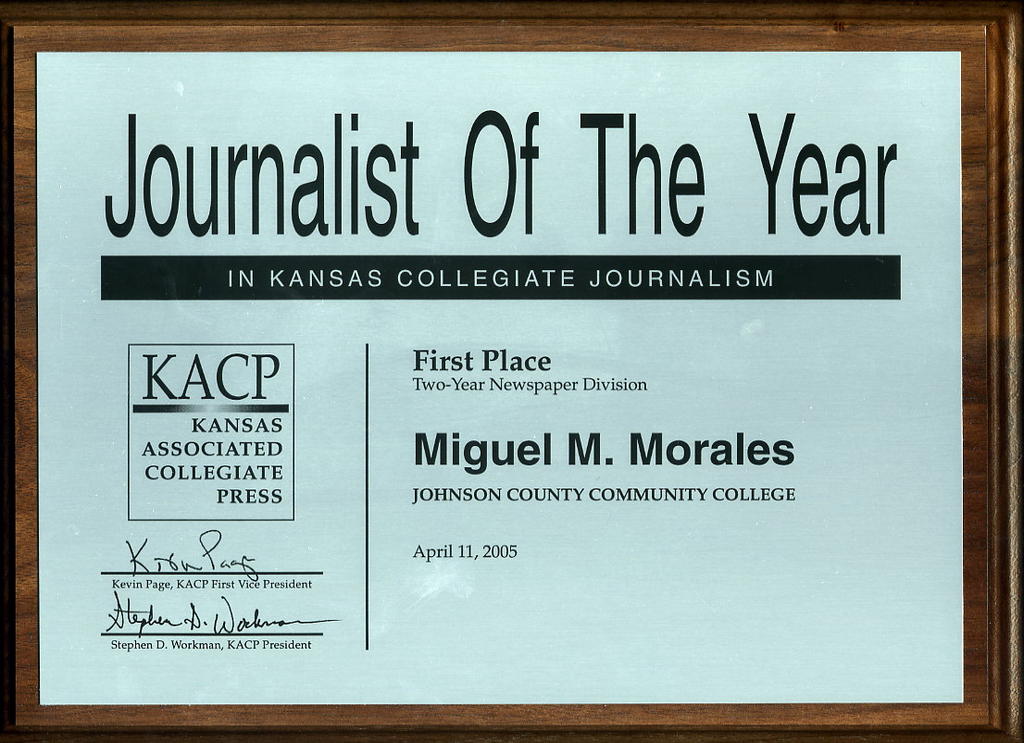
AWARD: Journalist of the Year

From a campus press release:

Miguel Morales, managing editor for The Campus Ledger, was named College Journalist of the Year by the Kansas Associated Collegiate Press at its convention in Wichita April 10-11.

The paper also won 19 individual awards.

Morales has worked as reporter, writing coach and editor-in-chief for The Ledger.

“I always knew one person could make a difference. It’s encouraging to know that sometimes that one person gets recognition,” Morales said.

In addition to Journalist of the Year for two-year schools in Kansas, for which he won a plaque and $250, Morales also won five individual awards.

Writers from The Ledger swept the feature category as the paper won first, second and third place. The Ledger received a bronze medal in the overall category. Other individual winners include:

  • First place – Miguel Morales, editorial writing; Shanxi Upsdell, feature writing; Aaron Whitebread, sports column writing
  • Second Place – Miguel Morales, feature writing and headline writing Kevin Mimms, editorial writing
  • Third Place – Miguel Morales, feature writing; Joshua Seiden, sports column writing; Dane Talley, news writing
  • Honorable Mention – Miguel Morales, editorial writing;Lisa Ash, single ad design; Robert Heishman, news photography; Kevin Mimms, sports feature writing; Shanxi Upsdell, column writing; Aaron Whitebread, sports column writing