Showing posts with label Kansas City Star. Show all posts

April 15, 2009

NEWS: Hodge's Power Point


Video courtesy of Cameron Fletcher of The Campus Ledger


Trustee Benjamin Hodge continued his efforts to challenge the Board of Trustees, JCCC President Terry Calaway and College Attorney Mark Ferguson on Kansas Open Meetings Act (KOMA) violations.

Read The Campus Ledger coverage of the alleged KOMA violations here (March 12) and here (April 13).

During the Petitions and Communications section of the board's monthly meeting, Hodge called for Trustees Lyn Mitchelson and Shirley Brown VanArsdale to step down from the leadership of the board. Unlike the last meeting in March, Ferguson, Calaway and the other trustees chose not to respond to Hodge.

Allotted 5 minutes to make his case, Hodge vowed to continue his PowerPoint presentation at the next board meeting. However, video provided by The Campus Ledger shows Hodge's presentation goes on for almost double the allotted time.

Before Hodge's presentation, trustees approved granting domestic partner benefits to full time employees. In 2006, the board approved adding sexual orientation to the college's non-discrimination policy and Student Code of Conduct.

Other board actions are listed in the Board of Trustee Summary posted on the college's electronic mail server, Infolist.

From: InfoList
Sent: Wednesday, April 15, 2009 6:49 PM
To: InfoList
Subject: [infolist] Trustee meeting summary

On April 15 the JCCC board of trustees met for their regular monthly meeting, immediately followed by a budget workshop. Trustee Jon Stewart was unable to attend.

Awards and recognition

The board welcomed the president and staff members from University College of the North, Manitoba, Canada, who are on campus to look at the college’s partnership with Burlington Northern Santa Fe and other learning opportunities.
Dr. Sean Daley, assistant professor, anthropology, was recognized for the work he has done with and for Native American populations.
JCCC’s men’s basketball team and women’s half-marathon team were honored for winning national championships. The volleyball team was recognized for being second in the national tournament.
The Nerman Museum has seen an increase in visitors of more than 18 percent in the first three months of the year, from 14,495 in 2008 to 17,239 in 2009.

Actions taken

· The board approved the treasurer’s report.

· The board approved clinical affiliate agreements for students in health care professions programs.

· The board approved new classes in animation, anthropology, biology, web, English, physical education, journalism, mathematics and psychology and a new career certificate in animation and game art.

· The board approved a proposal from HMN Architects, Inc., for architectural services and associated subconsultant services for the Health Services Educational Center at Olathe Medical Center, in an amount not to exceed 5.75 percent of the guaranteed maximum price construction cost. The estimated cost for architectural services is approximately $723,750, plus usual and customary reimbursable expenses.

· The board approved the lowest acceptable bids of $36,533.70 from All Sun Plus and $99,651.75 from Alexander Open Systems for Cisco equipment to be used in the Billington Library data closets to upgrade and improve network speed and reliability.

· The board approved several recommendations regarding employee benefits.

o A flex benefit amount of $1,189.88 a month for each full-time position to be used to cover the costs of benefits within the flex benefit plan. Fixed flex credit funding does not increase from FY 2008-2009.

o A contribution equal to 7 percent of each full-time, benefit-eligible staff member’s base salary to his or her individual 403(b) account, effective June 1, 2009.

o Employee group medical insurance with BCBS of KC for a period beginning June 1, 2009, through May 31, 2010. Monthly subscriber rates will not exceed, for single, $465.15 Blue-Care HMO and $836.40 for Preferred Care PPO; for an employee and one dependent, $852.88 for Blue-Care and $1,538.18 for Preferred Care; and for family, $1,169.29 Blue-Care and $2,035.05 Preferred Care. The rates represent a 5.5 percent increase in premiums and include domestic partner coverage

o Employee group CDC managed care dental insurance with Cigna Health Care for a period beginning June 1, 2009, through May 31, 2010. Monthly subscriber rates are, for single, $24.76; for an employee and one dependent, $50.23; and for family, $77.40. These rates represent a 6 percent increase in premiums and include domestic partner coverage.

o Employee group Passive PPO dental insurance with Delta Dental for a period beginning June 1, 2009, through May 1, 2010. Monthly subscriber rates are, for singles, $32.64; for an employee and one dependent, $63.73; and for family, $113.21. These rates represent a 4.75 percent increase in premiums and include domestic partner coverage.

o Employee group vision insurance with Vision Service Plan (VSP) for a period beginning June 1, 2009, through May 31, 2010. Monthly subscriber rates are, for single, $15.32; for an employee and one dependent, $22.37; and for family coverage, $40.12. There is no increase in the rates this year compared to last year.

o Provision of employee group life insurance with Sun-Life of Canada for a period beginning June 1, 2009, through May 31, 2010. Monthly rates are $.255/per $1,000 of insurance for Basic Life, $.195/per $1,000 of insurance for Optional Life, $.02/per $1,000 of insurance for Basic and Contributory AD&D; and for dependent life insurance at a monthly subscriber rate not to exceed $3.03 per month. There is no increase in the rates this year compared to last year.

· The board also approved the annual renewal of the contract for administration of the college’s flexible spending account program with Cafeteria Plan Administrators LLC at a total annual expenditure not to exceed $55,000.

· The board also approved bids for an Internet protocol (IP) addressing system, to replace the floors in the Commons dining area, and for a project portfolio management solution for Information Services.

Budget workshop

Four trustees reviewed the college’s proposed 2009-2010 budget of $134,254,187, which is 6 percent lower than the 2008-2009 budget of $142,917,552. The budget was built on these assumptions:

We’d see a 4 percent decrease in assessed valuation from the county, a 13 percent decrease in monies from the state and a 3 percent increase in enrollment.
There will be no increase in the mill levy this year.
There will be a $4 increase in cost per credit hour for in-state students and a $10 increase for out-of-state students.
There will be no increase in staffing.
There was no increase in operation budget (except for expenses, like utilities, that are difficult to control). Capital budgets were based on need.
Students presented a proposal for a “green” fee that would be assessed students to support sustainability initiatives. One collar of the tuition increase will be used for this purpose.

The board will approve the college’s 2009-2010 management budget at the May board meeting and the legal budget in August.

Next meeting

The next meeting of the JCCC board of trustees is at 5 p.m. May 21 in the Hugh W. Speer Board Room, 137 GEB. Board of trustee meetings are open to the public. For more details, see a copy of the board packet at http://www.jccc.net/home/depts.php/000001/site/BoardMeetingInfo/JCCCBoardReports

March 10, 2009

Town Hall

From the Morales for JCCC Trustee campaign blog


JCCC President Terry Calaway held town hall meeting at JCCC, March 6. He discussed the PrimeBuzz incident as well as the budget. Calaway joked that another of the cost-cutting measures on the infamous list included eliminating cookies from meetings but that somehow didn’t make the PrimeBuzz ....

Read the full post here.

March 5, 2009

Hodge Podge

"As is often the case with board members (who don’t experience the day-to-day environment of the college), I really do not know what the average employee thinks about all this – or whether the average employee even knows or cares." - Benjamin Hodge, JCCC Trustee


Trustee in Trouble
Benjamin Hodge responds to campus chaos and confesses he leaked infromation from a closed-door session of the board

[Full Disclosure: I am among 10 candidates, including Hodge, seeking election to four seats on the JCCC Board of Trustees, April 7.]
JCCC Trustee Benjamin Hodge, who is up for re-election this spring, set off a firestorm on campus last week when The Kansas City Star's PrimeBuzz blog posted information Hodge "leaked" from a closed-door session.

Tuesday afternoon, JCCC President Terry Calaway responded in a statement sent on the college's electronic server, Infolist. Today, Hodge responded with his own statement firing back at Calaway and suggesting the board of trustees, of which he is part, misinterprets Kansas Open Records laws.

This isn't the first time Hodge's actions have caused campus chaos. Two years ago a campus-wide vote called on the Board of Trustees to censure Hodge [correction: there was not a campus-wide vote against Hodge. The vote came from the Faculty Association. The campus-wide vote called for a vote of "No Confidence" against Trustee Chair Elaine Perilla]. Hodge also voted to against providing information to the public when he supported a vote that denied funding to the student newspaper.

Here's Hodge's press release (links included come from Hodge's document):

Benjamin Hodge
Johnson County Community College Trustee, 2005-
hodge@jccc.edu
Wednesday, March 4, 2008

“Where the First Amendment is implicated, the tie goes to the speaker, not the censor.”-- US Supreme Court Chief Justice John Roberts, writing for the 5-4 majority in the June 2007 decision FEC v. Wisconsin Right to Life (PDF), which declared unconstitutional a portion of the federal law known as “McCain-Feingold”

There is a law called the Kansas Open Meetings Act (KOMA). One premise for KOMA is that it is more important to protect citizens from government than it is to protect government from its citizens. If one side should be on the defensive, it should be government: government should fear its citizens, not the other way around. Another premise for KOMA is that humans are flawed and easily corruptible; we are at our best when held accountable.

The basic function of KOMA: it is almost always illegal for elected officials to gather in a private meeting to discuss government business. A closed meeting is allowed only in a few situations.

Here is information about KOMA provided by the Kansas Press Association (PDF), and here is information from the Kansas Attorney General (PDF).

What Chief Justice Roberts stated in FEC v. WRTL is that where there is uncertainty with regard to a citizen maintaining free speech rights, we will err on the side of free speech. In the same frame of mind, I believe that where there exists doubt about whether Johnson County Community College should be allowed to discuss a certain topic in a closed session – if one could “argue either way”– that the board members must err on the side of openness. The tie goes to the public, and the decision for an open meeting.

To change topics: There is a recession. As JCCC employees should know, property values have decreased in Johnson County. This will clearly impact our budget. Revenue to the college only arrives from a few places. Primarily, three sources: tuition, local taxes, and state taxes. JCCC also does have a healthy cash reserve, and I hope that the administration and the majority of board members are willing to have a full discussion about whether to access those dollars; because there has been very little discussion so far about that, I will not right now assume that accessing our reserves is likely.

The state obviously doesn’t have any money, in large part due to the 2005 Montoy decision whereby the Kansas Supreme Court illegally increased K-12 government school spending by tremendous amounts.

My expectation is that the JCCC board will approve reasonable tuition increases at rates similar to inflation rates of recent years. Inflation is a fact of life, and fees must go up. But tuition increases alone will not balance the college budget.

Two options are left: property tax increases and budget cuts.

Taxes: I have clearly stated that I am opposed to any new taxes. In November 2008, I wrote a letter to The Kansas City Star and objected that the majority of the board is willing to consider the possibility of a tax increase. In December 2008, some of my colleagues replied in a letter to The Star, stating that it was incorrect for me to write that they are willing to consider raising taxes; rather, they are still considering all options, including tax increases.

Today, as I write this, I am confident that the board will not increase taxes. It could happen, but I doubt it. A necessary path for the administration and board is cutting the budget – everybody knows this.

At the most recent board meeting, during a closed session, a five- or six-page paper was handed out to board members. The document summarizes about 50 uses of money that, if decreased or removed, would help balance our next budget. There’s really not much to say about the document. It simply lists and describes all kinds of ways to potentially decrease the budget. It makes clear what, I would think, is obvious: almost any area of the college is under consideration for a budget cut.

About a week later, I talked on the phone with Star reporter Jim Sullinger. Sullinger contacted me and asked if I could provide information with regard to how JCCC – like all area government bodies, particularly in Johnson County – will deal with tightened budgets. I said: yes; although, some information I have was handed out during a closed session. He challenged me: now, why was it given out during executive session? I thought about it: you know what, Jim, you’re right; this document could have just as easily been handed out during an open session.

I agreed with Sullinger that there is nothing legally sensitive about this document. There is not one employee name mentioned. Is the information politically sensitive to a variety of people? Sure, but that’s irrelevant. What matters is whether a reporter had a right to see the information. Can it be debated whether or not a reporter should see the information? Maybe. And that is where I will unapologetically restate my belief that when a government official or a government employee is in doubt about whether or not information should be private: the tie goes to transparency.

Sullinger wrote one article briefly covering the information. Nothing he wrote in that article was inaccurate. I could be wrong, but I think it only appeared online, on the political blog “Prime Buzz.” Not all that many people would have read it, and it would have simply been “bumped” down on the blog as new articles were posted, had there not been an overreaction to the article.

I am aware that some KNEA faculty members and Dr. Terry Calaway have been highly critical of my “leaking” the information. As is often the case with board members (who don’t experience the day-to-day environment of the college), I really do not know what the average employee thinks about all this – or whether the average employee even knows or cares.

I’ll summarize my reaction to the criticism:

• As I’ve stated, the information was general, non-sensitive. The public has a right to view the information.

• Dr. Calaway’s message on Tuesday to the college Email infolist: it did a disservice to the college. Calaway writes:

o “The reporter subsequently listed a number of items that are purportedly under consideration to be cut or reduced.” Well, the items are under consideration.

o “The blog article purports that the college has already defined a course of action.” No, it doesn’t. “Under consideration” means exactly that.

o “The irresponsible nature of this reporting…” If you’re going to pick a fight with the biggest paper in the area, make it over the right issue. The Kansas Open Meetings Act is not the right issue.

o “…had taken place as part of a board of trustees executive session…” Don’t remind us of that.

o “The reporter never called me with questions regarding possible budget reductions or to ask for comment. Unfortunately, the article on the blog leaves the reader with the assumption that he had done so.” No, I don’t think it did leave the reader with that impression. But even if it had, reporters are often going to write things that we don’t agree with. Bias exists in the media.

• That The Star article contained information that was a surprise to employees: I’m surprised that you’re surprised. Most ideas for cutting the budget are under consideration. That’s all the article said.

• Really?... KNEA faculty – you’re comfortable knowing that the board and administration interpret broadly, rather than narrowly, the exceptions permitted under KOMA (PDF)? I hear no concern.

• Here’s what I have not heard, but that I would certainly ask if I were an employee: What’s NOT on this list? Will the board really be willing to separate the wants from needs? Will the board cut back on my job, my friends’ jobs, or my department – even though they’re unwilling to cut back on these other things that are much less important?

o Bottom line: I could point out $1-2 million of spending that I view as either waste or non-vital, and that I would to cut before deciding to affect 99% of departments and employees. But I’m just one voting member of the board.

Lastly, I need to address why this document was given out during the executive session. The argument for secrecy is quite simple, and quite weak: because the document details how budget items will be cut, it therefore affects individual employees within those areas, and it’s therefore a personnel issue. Using that line of thinking, literally any discussion of taxation or budgeting could be interpreted as affecting individual employees. This type of interpretation happens all the time around local governments in Johnson County. I am not going to say right now that it violates the KOMA, but I will state that I do not support this interpretation, and I’m confident most taxpayers would not support this interpretation.

July 23, 2008

BREAKING NEWS: Kelsey Smith's Killer Pleads Guilty

Kelsey's Army Witnesses Justice

The Kansas City Star reports Edwin Hall has pled guilty to the murder of Kelsey Smith.

Hall abducted Smith outside a Target department store June 2 2007. Police discovered her body four days later and arrested Hall.

Smith's father, served as a public safety officer at Johnson County Community College and is a former police officer. News of the plea was posted on the college's electronic mail server, JCCClist.

Read The Star's article and watch video of the hearing here

Related: Kelsey's Army online

June 16, 2008

NEWS: Falling Star

The Kansas City Star announced today that it will cut 120 full-time jobs. The cuts support McClatchy's effort to cut 1,4000 jobs nationwide. In 2006, McClatchy purchased Knight Ridder, the former owner of The Star and dozens of other papers.

This move will further affect coverage of the college. Last year, The Star eliminated it's education reporter position and since then news of JCCC has taken shape in newsbriefs culled from the college's press releases.

The effort to cover the college will fall to the smaller papers like The Johnson County Sun, The Olathe News and to the campus newspaper, The Campus Ledger.

May 23, 2008

NEWS: Hodge Conjecture

No, the math problem known as the Hodge Conjecture hasn't been answered but conjecture about Benjamin Hodge, Johnson County Community College trustee, has been.

Hodge announced May 22 his intention to run for Kansas State Senate in Johnson County's 8th district. Hodge resigned his seat in the Kansas House as 49th district representative at the end of the veto session earlier this year.

Many speculated Hodge would run against Democratic incumbent Sue Storm for the 22nd district representative seat in the House. Yet Hodge's announcement has him seeking the seat of Barbra Allen, Republican, who will not run for reelection.

According to Hodge's press release, he intends to file today but as of 7 pm, the Johnson County election webpage failed to list him. The Kansas City Star's Prime Buzz reports that three other Republicans are considering vying for the seat as well.

Part of Hodge's platform focuses on taxpayer lobbyists.

"All across the state, government bodies hire lobbyists at taxpayer expense," Hodge said in the release. "These lobbyists then work against the interests of taxpayers. This practice needs to stop."

However, the JCCC Board of Trustees employs a lobbyist for Johnson County Community College.

Read Hodge's announcement here.

May 13, 2008

COMMENTARY: Tales of Two Students

Walking on the Ledge: Student Life
Sometimes the best thing a college can provide is stability


Thor Nystrum stands in the parking lot where a fight in 2003 triggered a breakdown that resulted in Nystrum begging a police officer to kill him. "Shoot me in the head. No one has to know," he begged. Photo by Rachel Seymore, courtesy of The Daily Kansan

Johnson County Community College plays a part in two recent stories focusing on students struggling with life challenges.


Current student, Cali Senkpeil, finds herself trying to keep her family together in The Kansas City Star's "Neighbors come to aid of brother and sister who lost parents."

Cali Senkpiel spent the past two weeks gaining custody of her younger brother, John Christian, and then helping move him into her apartment. At the same time all that was going on, there was one other responsibility the 20-year-old needed to fulfill — make funeral arrangements for her father.

Once those matters were settled — difficult as it was — Cali felt strongly that she had to keep moving. So this week she headed back to her classes at Johnson County Community College.

Former student Thor Nystrum, describes his break and mental health recovery in The Daily Kansan's "To Hell and Back."

Upon returning home, I inform my parents I will be returning to Kansas. They call it a “terrible, terrible decision.” I have enrolled in spring classes at Johnson County Community College, and I have agreed to sublease a place from a student in Lawrence. They attempt to talk me out of it.

“This is what I’ve decided to do,” I say. There is a conviction in my voice that I haven’t felt in more than a year.

Published within days of each other (Cali's story on May 2 and Thor's on May 5) these articles illustrate how the college serves as a grounding force in students' lives -- especially in times of need.

I hope Thor and Cali inspire us to make our campus a better place. They show us that responsibility doesn't come by simply following the rules but though understanding them. They also show us that breaking the rules is as an essential a skill as following them.

The articles remind this administration watchdog that I need to tell students' stories more often. Wt think that investigations uncover truth -- and they do -- but so do these stories.

May 9, 2008

COMMENTARY: Regret the Error

Walking on the Ledge:
Errors that Influence
Was Learning Management System Vote Tainted by Student Newspaper?

Every campus newspaper staff wants to influence campus – but not through errors.

An article in the April 24 issue of The Campus Ledger reported Johnson County Community College (JCCC) will abandon its current Management Learning System (LMS) powered by Blackboard in favor of one powered by ANGEL Learning. The article also reported the LMS will be in place by fall 2008.

The problem? The faculty was in the midst of conducting a vote on whether to adopt ANGEL. A day after the story ran, a posting on the college's electronic mail server, Infolist, voiced faculty concerns.

“Contrary to the Campus Ledger article, the college's move to ANGEL Learnin
g is not a forgone conclusion,” the post read. “We're in the middle of the faculty vote to support or not support the move to ANGEL Learning. Faculty votes count and are crucial as no decision will be made until the voting time period concludes on Monday, April 28, 2008 at midnight.”

The posting said if the vote is affirmative, the faculty’s recommendation moves to the Academic Technology Advisory Council, the Executive Council, the Board of Trustees’ Finance Committee and then to the entire Board of Trustees. A negative vote from faculty could stop the process, as could a negative finding by any of the committees along the way.

“If approved by all parties, the timeline for the implementation of a new LMS still needs to be developed,” the posting continued. “Any assumption that faculty and students will be using a different LMS for fall 2008 is premature. Implementation will require more time than exists between the board vote and the start of fall classes.”

Read the faculty post here.

A few faculty members asked how the paper could publish these errors and who, if anyone, checks facts. I explained the editing process I helped establish during my tenure at The Ledger. A minimum of three editors check the story and the staff reviews the proofs, or “minis,” for errors on production night. Yet, I agreed the article’s factual errors also could serve as errors that influence.

“Maybe this calls for something more than running a correction in the next issue, perhaps a staff ed?” I wrote in an April 29 e-mail to the Ledger's adviser, editor in chief, and managing editor. “I know the situation sucks because everyone loves to point out when The Ledger makes a mistake. But if it's not addressed then the integrity of the paper suffers especially on the heels of some prestigious awards this year.”

The next day, six days after publishing the article, The Ledger posted a correction and apology on Infolist.

“It has come to the attention of The Campus Ledger that the April 24 article about the Blackboard Learning System contained incorrect information,” the post read. “It was not our intention to sway the vote for a new learning management system ... Our staff will take this experience to heart. We plan to continue providing the quality, accurate news that you have come to expect from our award-winning newspaper.”

Read The Ledger post here.

Seeing this as a teachable moment, I asked the Ledger's adviser, editor in chief, managing editor and the reporter how the situation unfolded.

Linda Friedel, managing editor, acknowledged ethics breach.

“We definitely consider it a learning moment,” Friedel said. “It is the worst mistake anyone has made on the Ledger this year.”

She said a meeting took place yet they could not identify the origin of the mistake.

“Either the reporter didn't make the question clear, the source spoke out of line, the source didn't communicate it was a done deal and the reporter thought it was a done deal,” she said.

Friedel said the most they could do was acknowledge the mistake and use it as an example of how not tor report.

Alexia Lang, editor in chief, did not respond to my question.

Anne Christiansen-Bullers, adviser, said she would meet with the reporter and Lang to discover how the errors happened.

The reporter, Bartholomew Klick, said a few days after The Ledger's apology posted, Lang abruptly fired him. He said she cited the errors along with an e-mail campaign he spearheaded against The Ledger for an unrelated story as reasons for his termination.

Yet, Klick contends he accurately reported the story. He said during the editing process, editors cut crucial information and left gaps they later filled with assumptions and other misinformation.

Klick provided his unedited copy showing the differences. His original lead reads:
“As quickly as autumn of this year, the college may have a new program for managing its online course material.”

The published version reads:

“Beginning this fall, the college will have a new program for managing its online course material.”

Read The Ledger article here.
Read Klick's original version here.

Klick said the only thing he regretted about the story was that he did not record and clearly document his interviews. Both he and Friedel agreed organized documentation would have identified errors and allowed corrections before publication.

Further complicating the situation is that everyone involved is an accomplished journalist. Klick and another staffer recently were awarded the college’s Robert J. Helmer award for excellence in journalism. Alexia Lang was named first runner up for the Kansas Associated Collegiate Press Journalist of the Year award in the two-year division. Friedel is a contributing columnist to The Kansas City Star’s Neighborhood News and Christian-Bullers has earned an advising award from the Collage Media Advisers association.

The faculty voted to endorse ANGEL Learning as it’s LMS. The recommendation now moves along the path to approval. Yet the question remains: did the reporting errors influence the vote?


Visit Regret the Error to read about media mistakes

April 10, 2008

NEWS: Hodge Resigns

Hodge-Podge
Benjamin Hodge resigns his position as Kansas' 49th District Rep.

During the Sept. 21, 2006 Board of Trustee meeting, Benjamin Hodge, trustee, questions a representative of the Faculty Association. The FA contended that presidential search committee, which Hodge co-chaired, violated Kansas law.
The Kansas City Star's Prime Buzz reports that Johnson County Trustee, Ben Hodge will resign his seat as representative of Kansas' 49th District.

According to The Star, Hodge will resign at the end of the month when he moves out of the district. The Star speculates Hodge may seek a seat in the more powerful Kansas state senate.

Hodge started serving the college in 2005. His term ends in 2009. There is no word if he plans to resign this position as well.

September 6, 2007

Opinion: Meet the FOC-ers

Walking on the Ledge:
Former JCCC president accused of unlawful harassment returns to public life thanks to low friends in high places

Charles Carlsen, former president of Johnson County Community College, has slithered his way back into public life thanks to the Johnson County Board of County Commissioners (BOCC).

A unanimous vote by the BOCC named Carlsen and six others to the newly formed Johnson County Public Arts Commission Aug. 30.

In 2005 while celebrating his silver anniversary as president of JCCC, Carlsen abruptly resigned when the student newspaper, The Campus Ledger, published allegations of sexual harassment against him.

Despite his public resignation and a statement from JCCC's Board of Trustees acknowledging other harassment victims, Carlsen continues to sit on the Board of Directors of the JCCC Foundation.

What does this have to do with the Public Arts Commission?

Annabeth Surbaugh, BOCC chair, and David Lindstrom, commissioner, currently serve on the JCCC Foundation's Board of Directors with Carlsen.

It was Lindstrom who nominated Carlsen to serve on the Public Arts Commission.

According to GuideStar, an organization that tracks public information provided by nonprofits, Lindstrom and Carlsen also sit on the Board of Directors of the Shawnee Mission Medical Center Foundation.

But Lindstrom and Surbaugh aren't the only commissioners with ties to Carlsen.

In 2005, The JCCC Foundation honored Commissioner Ed Eilert as Johnson Countian of the Year.

Commissioner Ed Peterson worked with Carlsen on the Bistate II tax proposal.

In 2002, JCCC hosted an Ingram's magazine event where Carlsen, Peterson, Surbaugh and others discussed Johnson County's economic future.

And while not incriminating, Commissioner John Toplikar attended JCCC as a student when Carlsen presided as its leader.

Upon his unanimous approval by the commissioners, Carlsen will represent the third district. But more importantly he now has the clout to strut around Johnson County and perhaps onto the JCCC campus free to terrorize his alleged victims and their families.

Teresa Lee, the woman who brought the first allegations against Carlsen, told the Kansas City Star that neither Carlsen nor his supporters ever faced the reality of the situation.

"It’s a small community, a tight-knit community,” she said. “I just don’t think they understood."

This is not the first time Friends of Carlsen, or FOCs, have tried to restore Chuck to his former glory.

Last December, at JCCC Foundation event "Some Enchanted Evening," Calrsen took his first steps in public. In support of Chuck, the benevolent Polskys committed thousands o
f dollars to a scholarship in Chuck's name and urged other FOCs to contribute.

I know his victims and others on campus would like to see his name removed from the Carlsen Center. And Chuck slithering back into public life might just be the incentive
they need.

September 4, 2007

NEWS: Environmentalist vs. JCCC

Here's another interesting item concerning JCCC in Angela Curry's At Your Service column published in The Kanss City Star Sept. 1.

College, patron at odds over mass mailing

I’m an environmentalist and am most concerned about the destruction of trees and the massive use of energy to produce and deliver unwanted direct-mail pieces.

I am constantly calling the offenders to stop sending catalogs that I don’t want. I’ve discovered an offender in my own city that refuses to address their non-green approach to marketing, namely Johnson County Community College.

I receive a catalog the size of a small phone book three times a year. I have never attended JCCC nor plan to do so. I called and asked to be removed from the mailing lists. A college spokesman said she could not honor my request. I was floored. She said that the college uses the cheapest possible way of mailing — that is giving a stack of catalogs that are marked “residential customers” to the post office for them to deliver to each mailbox.

She suggested I contact the post office.

I learn that the college mails 211,000 of these catalogs three times each year. I can only imagine the waste of trees, electricity to run presses, toxic inks to dye the cover, and gasoline to ship the catalogs to their distribution points. JCCC said this is a community service. I do not perceive this misuse of energy as a service. — A.B., Prairie Village

Dear A.B.: Julie Haas, a spokeswoman for the college, confirmed that JCCC’s continuing-education class schedule is mailed to every household in Johnson County three times a year — October for the spring semester, March for the summer sessions and July for the fall semester.

“Because it’s the college’s mission to offer all kinds of educational opportunities to county residents, we feel it’s important to communicate what we have to offer to all county residents,” Haas said. Most U.S. community colleges follow the practice, she said.

Haas said that the fall continuing-education class schedule is printed on inexpensive newsprint, and at 124 pages, it is hardly the size of a small phone book. Haas said that no taxpayer funds are used for this, because continuing education classes are self-supporting. The program pays for the schedule from the revenue it earns from classes, Haas said.

Haas also said the college is able to economically distribute the booklet through saturation mailing, for which it pays the lowest postage rates.

Shawnee Mission Postmaster Russell R. Jacobson confirmed that the college takes advantage of the rate for saturation mailings, and as such each letter carrier is required to distribute the mailings to each residence on the route.

Jacobson also said that the Postal Service is required by federal law to deliver all mail that has been paid for.

Even though you mentioned that you had contacted the Direct Marketing Association to have your name removed from mailing lists, the organization said consumers may continue to receive mail from non-DMA member companies and also local merchants, professionals and alumni associations, political candidates and office holders, and mail addressed to “resident/occupant.”

Jacobson said that even though the Postal Service must deliver such mailings, you can mark “Refused” on the mailing and return it unopened to your letter carrier.

September 2, 2007

NEWS: College Punishes Protester

Anti-war Activism Unfurls on Campus
JCCC fires employee and former student for protesting Iraq war.
by Miguel M. Morales

Kaedden Timi admitted unfurling a 20-foot square anti-war protest banner during a political debate at Johnson County Community College Aug. 13.

"I did it," Timi told the student newspaper, The Campus Ledger, Aug 30.

Days later the college fired him.

Timi, a employee in the college's theatre department and a former student senator, released the banner during a political debate between Rep. Dennis Moore (D-Kan) and Sen. Pat Roberts (R-Kan). The two policticians participated in an event dubbed "Reaching Across the Aisle: Bipartisanship in Washington, D.C."

Near the end of the debate Timi released the banner that read:

"Guilty of Crimes Against Humanity: bush/Cheney & Their Administration
Pat Robers & the Senate
Dennis Moore & The House
End The War In Iraq Now!"

Timi posted a letter Aug. 26 on AfterDowningStreet.org describing his actions.
"To fall on ones own sword has never been so gratifying!" Timi wrote. "Hopefully it was Moore and Roberts who felt the sword of justice at their throats' [sic] for if they do not start listening to their onstituents and put an end to the profiteers' war then surely they too will 'fall on their own swords.'"

According to the website, Timi knew the college might fire him for his actions. College policy 422.02 Political Activities states that employees are free to engage in any activity afforded "any free citizen." However, the policy also states that employees may not use college property, school equipment or materials.
The Kansas City Star reported Aug 31 that JCCC fired Timi not for protesting but for possibly placing the audience in danger.

June 21, 2007

NEWS: Perilla Shuns Trustees

Perilla passes on final meeting
Remaining trustees meet, welcome new president

Ending the financial year, Johnson County Community College trustees welcomed new president, Terry Calaway, at their monthly meeting, June 21.

Calaway took the helm June 18 when Larry Tyree departed June 15 after serving 11 months as interim president.

The meeting was also the last official meeting for trustee and former board chair, Elaine Perilla.

"The trustees also recognized Elaine Perilla, who is leaving the board, for her 12 years of service. Mrs. Perilla, who was absent from the meeting, will receive a plaque and a vase," read a posting on the college's e-mail list server that recapped the meeting.

Perilla's pained past
Perilla's no-show ended her term under a campus-wide No Confidence vote that stemmed from allegations that she new of and dismissed allegations of harassment against former President Charles Carlsen.

Carlsen resigned April 20, 2006 a week after The Campus Ledger, JCCC's student newspaper, published its 13-month investigation into the charges.

Trustees acknowledged and validated the claims of harassment against Carlsen in a press statement Oct.19, 2006. Perilla's sole vote against faile to prevent the board from realeasing it.

"Concerning [the victim's] public allegation that she gave her written narrative in 2004 to Elaine Perilla and told Ms. Perilla then about her allegations against Dr. Carlsen, [the victim] and Ms. Perilla disagree about whether these events occurred," the statement reads.

Perilla's history with the college began in 1985 as a biology and anatomy instructor.

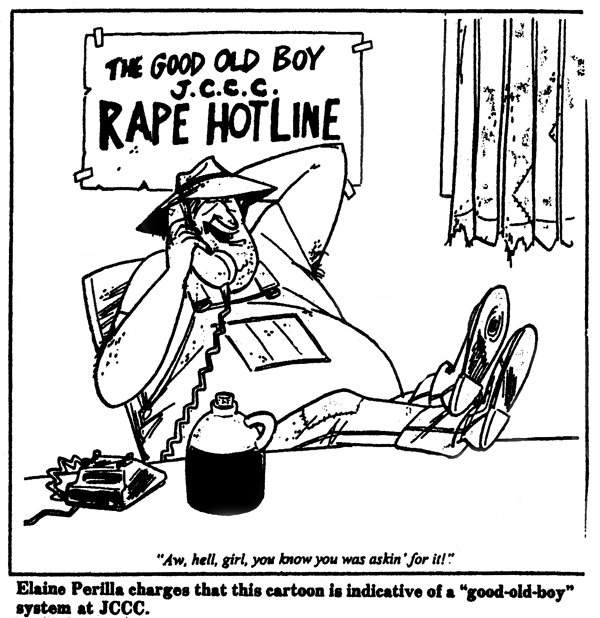
After leaving her position, Perilla leveled charges of sexual harassment against the Carlsen Administration. She brought a cartoon that was circulating around campus as evidence.

“I have experienced firsthand the verbal harassment and sexual discrimination of our very elaborate ‘good old boy’ system at the college,” Perilla said during a board meeting June 22, 1992.

After the meeting, Perilla said she would focus on addressing issues of sexual harassment, financial waste and mismanagement in her campaign for a seat on the board. Perilla failed to garner enough votes.

In 1995, Perilla succeeded in securing her seat with the endorsement of the college's Faculty Association.

Twelve years later, the same Faculty Association spearheaded the call for a the vote of No Confidence in Perilla.

"I've done 12 years, and it's time for someone else," she told The Kansas Star.

Current trustees, Lynn Mitchelson and Jon Stewart secured seats on the board in the last general election as did newcomer, Don Weiss, dean of evening, weekend and graduate studies at DeVry University in Kansas City.

Weiss will take Perilla's seat on the board at the next trustee meeting, 5 p.m. July 12 in the Hugh Speer board room, 137 GEB.

Board of trustee meetings are open to the public.

June 13, 2006

BREAKING NEWS: Do the Right Thing

The Kansas City Star reports the Board of Trustees has hired my favorite of the three interim president candidates, Lawrence W. Tyree.

Previously, trustees announced they would name the interim president of Johnson County Community College at their regular monthly meeting, June 15.

Tyree temporarily replaces Charles Carlsen who voluntarily retired after I broke the story alleging he sexually harassed an employee. Tyree will also aid in the search for a permanent president.

The college's information listserv (infolist) reports trustees will also name Teresa Williams as vice president of student services. Williams, from the University of Richmond, attended Washington University in St. Louis, Mo.

Williams replaces Jon Long who resigned prior to the Carlsen scandal noting his inability to effectively advocate for students due to an atmosphere of institutional intimidation. Long sought to keep his job after the scandal broke. He said Calrsen's departure meant drastic changes ahead for students and staff and that he'd like to help guide them through the change.

It seems the trustees will hire both of my favorite candidates. Does this mean they're on the right track? Well, its like I told a source, "I'll never underestimate the board doing the wrong thing at the right time and the right thing at the wrong time."

For a while it seemed like the trustees deliberately did the wrong thing -- all the time. I mean, if it wasn't deliberate then just by sheer coincidence, they would have done the right thing at the right time.

In this situation, I think a happy coincidence happened -- twice.

July 29, 2005

INTERNSHIP: Star Reporter

With three assignments awaiting publication, my internship at The Star ended July 27.
Josh and I met with JCCC's professor of journalism and media communications Mark Raduziner and associate professor of journalism Greg Harrell to discuss our internship experiences and turn in our documents, evaluations and a research paper.
Here is a list of articles carrying my byline though not every story I wrote had a byline for some reason and therefore they aren't included. Some stories carry the correct byline of Miguel M. Morales. Others simply use Miguel Morales. One came with a byline of Manuel M. Miguel, which I don't really understand.
Besides learning how to bang out stories on the fly, the best part of the internship came when Shawnee Mission Neighborhood News editor Mark Anderson offered us both freelance contracts.

Now comes the transition from intern to freelance journalist which brings a whole new angle to newsroom relationships we've established this the summer.

July 16, 2005

INTERNSHIP: Sleeping dogs into Watchdogs

I'm preparing for my second Roland Park city council meeting. The first proved difficult for a few reasons.
  1. TMI - So many documents, budgets and plans; motions, discussions and votes; don't forget ranting residents. It almost makes me feel sorry for politicians -- almost.
  2. Q & A - Despite information overload, questions arose. As we moved through the agenda, I constantly revised my questions and list of sources to answer those questions.
  3. ID - council members have name plates but who were all those other people? Why did that old dude sit there for two hours? He wasn't even paying attention. Why the hell don't city employees say their names before they speak?
  4. PDQ - Absorb, process and interpret information. Quickly adjust and prioritize items for the story. Get those questions answered before council members finish grazing at the refreshment table and head for their SUVs. Quickly get to a computer and write the story for tomorrow's edition.
  5. AEQ - Josh usually covers this beat. He revitalized the meeting notes, as the paper calls them, raising reader interest. I felt pressure to equal his efforts while adapting them to my style. Besides a 200-year-old parasite at a competing paper decided to attend the meeting instead of writing his copy off the agenda and Josh's published article. I had to write tight, well-organized copy in order to deter him from plagiarizing my work.

At the next meeting the Roeland Park PD will present (and hopefully demonstrate) Taser technology in order to get the council to approve and allocate funds for it.

It's great having an editor who trusts me to cover city government.

July 12, 2005

INTERNSHIP: Independence Day

Spurred by a required meeting with my journalism instructor, I met with my supervisor about my internship. I laid it all out saying I didn't feel challenged, the quality of my work was slipping and, at the risk of sounding like a clip whore, that I needed clips.
He responded by immediately approving three story pitches, granting my request to work with other editors outside our bureau in addition to my in-house assignments and offering feedback on my stories.
I still don't have a desk, voicemail, e-mail or experience working on the software or in their newsroom (I'm convinced this is training for a future as a freelance journalist).
What I do have comes in confidence in managing my boss, initiating a difficult conversation and learning how to be proactive without being a bitch -- well, at least to my boss.
We learn these lessons in our college newsrooms but sometimes we don't know how to apply them to our internships. Accustomed to our roles as editors and managers in our college newsrooms, standing as a reporter in a strange newsroom makes us feel like our first semester in Introduction to Newswriting.
No matter how far up the ladder we travel in our respective newsrooms, we should always remember the courage and uncertainty we experienced stepping on the first rung.
It’s easy to remember those who encouraged us though we must not forget those who challenged us.

June 7, 2005

INTERNSHIP: Size Matters

I submitted my piece on El Centro's 30th anniversary today. As ususal when I started writing this weekend I had too many words and sources. However I kept getting this feeling I needed more. I tried contacting others sources but they were in meetings or just didn't want to talk to me. I guess the journalism gods were telling me to just finish the damn story.
In an industry where we measure by inches, I've counterintuitively learned bigger isn't always better. But how do we know when its big enough? Journalists never finish their stories, we just surrender to the deadline.
I haven't mentioned Josh in this posting? He brought me a paper with one of his stories. I'm so proud of that kid.

June 5, 2005

INTERNSHIP: Silver Linings

Finally!

Josh sent me an e-mail yesterday informing me The Star published my story last Wednesday. That's something I should have found out from someone at my bureau.


My first story published in The Kansas City Star. Unfortunately you must register as a user of the website to read it. It's free.

Reading it over, its pretty much what I wrote. However it now contains a factual error, more being verbs and a lede that ends with a preposition -- which I usually don't do.

Yes, I'm pointing out a half-empty glass while reminding everyone lemonade comes from lemons. Despite my Debbie Downer demeanor in social settings, this negative and slightly paranoid quality helps as a journalist.

I'm working on a story about local organization celebrating its 30th anniversary. At the event, I found myself in the path of the mayor of Kansas City, Kan. Taking a deep breath and a small step to the left, I stopped him in his tracks and fired off a few questions about the urban core, immigration and the unified government.

Unfortunately, in my haste I forgot to press record on my voice recorder. With handwriting as bad as an editor's, my notes read like a first grader's handmade Mother's Day card. So I either paraphrase the mayor or follow up the quotes with a phone call Monday.

June 3, 2005

INTERNSHIP: Inequalities

I need to initiate a difficult conversation with my supervisor.

When I interviewed for the internship my nose for news immediately told me something was wrong. Disregarding this instinct, I let things slide. Pushing forward (and my doubts aside) I accepted my post with its limitations. After all, I'm just an intern and they know what they're doing, right?

"The word 'slave' is so degrading. Why don't we call you
'intern.'"

New Yorker magazine Feb. 16, 2004


Yet even before our internships officially start, Josh's supervisor gave him a desk, e-mail, voice mail and server access. Josh is already being published, working choice story assignments, becoming familiar with the software and most important -- he's learning. Josh is a good man and after a year of overcoming management's obstacles at The Campus Ledger, he deserves a chance to shine.

My difficult conversation comes from knowing the inequities of our internships. Three years of college newsroom management experience taught me that a supervisor cannot treat every staff member the same.

Having researched and written style guides and policy manuals, I know they set the minimum standard. Conversely, they don't set the maximum level of supervision and guidance either.

Individuals in different departments with various levels of experience demand specialized attention. Treating everyone equally is not the same as treating them fairly.

I, like other interns, simply want the basic tools others have to do their jobs. We want to learn the minimum standard so we can exceed it. We want the same chance to learn and shine.